1
In July 2026, I was invited by the Fondazione Tullio Castellani to spend two weeks in residence at Bosco di Sant’Andrea, in the mountains of Umbria, central Italy.
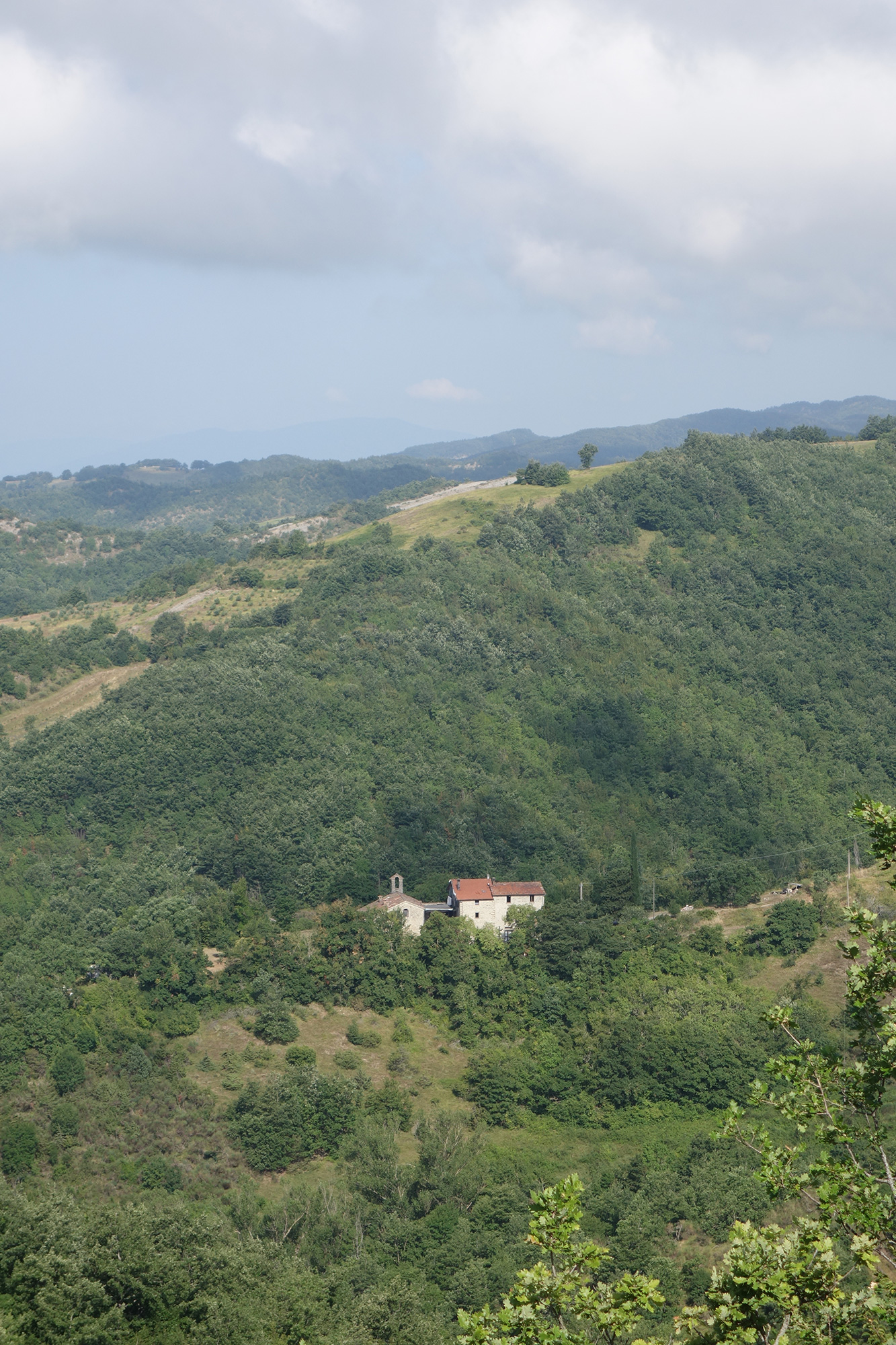
Bosco di Sant’Andrea is located on a ridge at about 600 meters above sea level, near the medieval town of Pietralunga. It is surrounded by mountains, with winding and hilly roads and abundant vegetation. The nearest neighbor lives on another ridge to the east.
The center of Bosco di Sant’Andrea is a Romanesque rural church, Sant’Andrea, built around the 12th century. Around the church are large areas of woodland and quiet mountain paths. Following the paths down through the forest, you eventually reach the spring where we collected the water we drank every day.
Sant’Andrea was once the center of this small settlement, where people from the surrounding area came to attend Mass. According to local people, it was still a primary school in the 1970s. Children from nearby villages and shepherd families came here to study, and a priest lived here and ran the school. Beneath the outer wall of the church stands a stone memorial with the names of eleven villagers who died in the First World War. They were all seventeen or eighteen years old. From their surnames, it seems that four of them belonged to the same family. Under the names are the words: “The people of Sant’Andrea present to future generations their children who made the glorious sacrifice.”
In the 1960s and 1970s, as Italy’s economic structure changed rapidly, young people began to leave the mountains of Umbria in large numbers. The local population declined, and farmland gradually turned back into forest. During the second half of the 20th century, as interest in Indian thought, Zen, yoga and other forms of Eastern spiritual practice grew in Europe, some Europeans began coming to these mountains to practice yoga, Zen, aikido, vegetarianism, meditation and retreat. They restored and occupied some of the old churches and hermitages scattered in the mountains.
Sant’Andrea was one of them. It later became the home of the Santi Borgni family, who lived here for thirty-seven years. In 2000 they founded Casa della Pace, a place for discussing the ideas of Jiddu Krishnamurti and practicing meditation through silence and dialogue. In 2025, Gian Carlo Calza and Monica Dematté of the Fondazione Tullio Castellani took over the place from Santi and named it Bosco di Sant’Andrea, meaning “the woodland of Sant’Andrea.”
On the roads below the mountain, especially on the way to Città di Castello, I often came across pilgrims walking towards Assisi under the strong sun, carrying heavy backpacks. In 13th-century Europe, trade and urban economies were gradually developing, while the Church had accumulated enormous wealth and power. Francis of Assisi, however, advocated Holy Poverty. He gave up his family’s wealth and returned to a life of simplicity modeled on Jesus. The famous fresco cycle “The Life of Saint Francis” in the Basilica of Saint Francis in Assisi tells the story of his spiritual pursuit and the miracles associated with his life.
Francis also believed in living with nature and animals. For him, the sun, moon, wind, fire, earth, trees, animals and human beings were all part of creation. Humans and the rest of creation were brothers and sisters, rather than things simply to be controlled or possessed.
This idea of a simple life, of living with nature and animals, has also taken root deeply in this region, forming a particular spiritual geography. For centuries, there have been hermitages hidden in these mountains, where people prayed in silence, worked simply, owned very little, lived with the forest and welcomed visitors. Later, modern retreat communities also came here to practice silence, awareness and a reduction of material desire. There were practices influenced by Eastern thought: meditation, awareness and self-education. There were also individuals and groups interested in ecological spirituality.
They were not necessarily developing the spirituality of Saint Francis, nor was there necessarily any direct line of intellectual or spiritual transmission between them. Yet their ways of living have sometimes been remarkably similar. Again and again, they have made some of the same choices: to value nature, to live with the forest and animals, to live simply, and to welcome people who have come from far away.
Bosco di Sant’Andrea is part of this history.
2
Bosco di Sant’Andrea continues the vegetarian life and yoga culture of Casa della Pace. It pays attention to natural and organic food and household products, to the relationship between people, nature and animals, and to a frugal and quiet way of living. In a letter written to residents, there is a sentence that says: “If possible, please reduce your use of mobile phones as much as possible… We value meaningful words and try to avoid habitual small talk, as this can help with your awareness.”
The place emphasizes exploration, participation and experience. It emphasizes learning about oneself through these practices, and education through everyday life.
I lived in a stone house on the south side of Sant’Andrea. It was probably once a room for a monk or priest. There is a small loft inside. The room is simple and warm: a single bed, a small wardrobe, a small desk and a chair, with a bathroom and shower. There is a small opening in the stone wall beside the bed. Every morning, a little after five, I could clearly hear the lively birds outside, and on stormy nights, I could hear nature very close to me, stretching and roaring.
In front of the house is a grape arbor covered with leaves. At the beginning of July, the grapes were not yet fully ripe, but the thick leaves and heavy clusters of grapes created an excellent shaded place to cool down. I often read and did my laundry under the vines.
There was almost no mobile phone signal here. This forced me to put work and outside communication aside and return to a rare state of being alone. I explored the mountain paths, took part in simple daily work at Bosco di Sant’Andrea, read for long periods under the grapevines, and learned to fall asleep calmly during nights of thunder and rain.
In the early morning, before the sun became too strong, I would go for a long run through the mountains. I did some simple physical exercises or meditation inside the old church, where a yoga mat was always kept on the floor, or cooled myself in the pool. In short, here you have to actively decide what to do, or what not to do. Sometimes I simply watched the small lizards moving quickly across the old stone walls under the strong sun.
Bosco di Sant’Andrea is looked after by Manu and Giulia, two strong and capable people with decades of climbing experience. They are extremely practical and seem able to do almost anything. Their daily work is extensive: repairing the buildings and equipment, taking care of the plants, cleaning the pool, feeding and washing the cats, dogs and donkey, walking around the property and checking the water sources.
Besides all this daily work, they also meditate and practice yoga almost every morning. And during my stay, they had to spend quite a lot of time cooking.
For four days, Manu and Giulia had to leave because of family matters. I stayed alone in the mountains and temporarily took over some of Manu’s work: cleaning the pool, keeping an eye on the electrical system, watering the plants and preparing food for Nina, the mysterious Maine Coon cat.
During those days I tried to cook for myself, although I am not very good at it. Faced with unfamiliar ingredients and seasonings, I spent a long time preparing each meal. Eventually I found a routine: oatmeal or bread in the morning, pasta at noon, quinoa in the evening. I cooked a lot of beans—red beans, chickpeas and dried beans—and sprinkled local dried cheese on top.
Whenever I was confused about what to do with dinner, I kept thinking about one of the ideas at Bosco di Sant’Andrea: “Everything here unfolds from the perspective of self-education.” Yes, everyday life itself had become a lesson again.
I liked walking and running in the forest with their dogs, Buio, Rumi and Zoe. One day, Buio ran 20 kilometers with me through the mountains. Along the way we met Giordano, a large white dog belonging to a family living on another mountain. The two energetic and friendly dogs ran the whole way with me. It was a very happy run.
After that, Buio became my best running companion and pacer for my morning runs. The three of them were often waiting outside my room, ready to go whenever I was.
3
Running is a sport for me, but it is also an important way of exploring terrain and the scale of a place. Whenever I arrive somewhere new, exploring the surrounding area by running is something I look forward to every day. Through this process, I establish a relationship between my body and the place, and also create a daily rhythm and discipline.
To avoid the heat, it was important to leave before 6:30 in the morning, and for longer runs I had to leave even earlier. I would take a bottle of sweet mountain spring water and run down from Bosco di Sant’Andrea to Pietralunga, walking and running alone through the quiet medieval streets in the early morning, and stopping to look at the Lombard fortress dating from the 8th century.
I also came across other abandoned rural churches and ruins in the mountains. Once, I even found the site of a plane crash from the 1980s in the forest. The pilot, Marco Cantarini, chose to crash his aircraft into the forest rather than let the out-of-control plane hit Pietralunga. His memorial and pieces of the aircraft still stand there.
On another ridge I saw a huge natural gas pipeline under construction. It is part of the Linea Adriatica, a gas infrastructure system running for hundreds of kilometers across Italy. The construction noise interrupted what was otherwise a very quiet mountain landscape. Local residents have also repeatedly written letters expressing their opposition to the project.
Running quickly taught me where the vegetation was dense and wild, where there were bare rock roads and muddy tracks. I passed pastures, farmland and vineyards, as well as a few hidden houses. Almost every morning I saw roe deer and wild rabbits.
At first I always mistook the roe deer I saw moving quickly in the distance for small deer. Only after asking local people did I recognize them the next time I saw them. I often ran to the ridge east of Bosco di Sant’Andrea and looked back at the place where I was staying. Sometimes, through gaps in the dense forest, I could recognize the bell tower of Sant’Andrea, which has stood there for almost ten centuries.
Running from ridge to valley, and from valley to another ridge, the hills of Umbria gradually became part of my bodily experience. The terrain entered the body through repeated physical practice—or, perhaps, through fatigue and rhythm.
Apart from running, another way of entering a place through the body and the senses is listening. I spent long periods listening to and recording the sounds of Bosco di Sant’Andrea with a portable recorder.
There were the noisy birds in the early morning, from the first few calls before dawn to the full chorus of the forest. Then, after around nine in the morning, the cicadas continued throughout the day. Their sound was extremely loud and rhythmic. For a while I thought it was the sound of a pressure cooker or someone cooking meat or porridge in the neighbor’s house.
For someone who has lived for many years on a cool plateau, I had not heard such intense summer sounds for a long time. By listening, I also heard the roe deer calling from the valley, sounding strangely like a dog barking.
Forest roads, beneath the grapevines, inside the church. Early morning, noon, evening and deep night. Clear days and thunderstorms. I spent long periods listening to these sounds from different spaces and times at Bosco di Sant’Andrea, observing the daily rhythm of a place. I tried to describe an acoustic map of the place through sound, although it was inevitably incomplete.
Unlike running, listening and field recording require me to keep my body as still as possible. No movement, sometimes even holding my breath. It is somewhat like what is practiced in a hermitage or a modern retreat center: to remain silent, to listen, to become aware.
Here, listening itself becomes a practice. Field recording can also be understood as a technologically assisted practice of silence.
4
Running, listening, reading, writing, talking, observing, walking, vegetarianism, daily work…
As my stay went on, I became increasingly curious about the landscape, history, spiritual traditions and ways of life of Umbria. From Saint Francis in the Middle Ages to the Christian hermitages that continued for centuries, from Theosophy to Krishnamurti, from Indian yoga to Japanese Zen, from modern retreats to ecological spirituality—what has brought these different spiritual practices to this place again and again, and allowed them to overlap?
Or, put another way, why have the hills of Umbria continued to attract forms of spiritual practice that move away from centers and trends, reduce material desire and turn inward?
Gian Carlo Calza told me that it took them ten years to find a place like Bosco di Sant’Andrea.
The mountains here are enclosed, the population is sparse, transportation is limited, commercial life is far away, and there is often no network signal. But this very environment forms a natural barrier, allowing people to focus on another kind of time—a time that is not accelerated and does not need constant updating.
The medieval remains scattered throughout the mountains are like signs left behind by people in the past. They remind us that someone has walked this path before, and that this way of living has continued for hundreds of years.
But these different spiritual communities and individuals have not formed an organization or network simply because of Saint Francis, a shared ecological idea, or the fact that they have lived in the same region for a long time. They are more like scattered settlements and islands of spiritual practice, living separately in the mountains.
Unlike today’s highly self-exposed life, in which everyday life is pushed into the stream of social media and increasingly turned into spectacle, these places maintain a form of life with low visibility and little circulation.
If I had not known where Bosco di Sant’Andrea was, it would have been almost impossible to identify it through the gaps in the forest or from another ridge. The same is probably true of many of the other retreat centers.
Life here does not pursue efficiency or convenience. Many objects, large and small, have been used for decades.
Before coming here, I changed planes in Shenzhen. Everywhere I looked, the advertisements were about artificial intelligence and robots: finance, entrepreneurship, transportation, city management, business operations, housework and even sleep.
I came from a city surrounded by images of future technologies to Italy, the country that gave birth to Futurism. Yet I found that within this country there is also an almost opposite experience of time.
It is not the speed, city, machine, production and visions of the future celebrated by Futurism. It is the forest, repetition, seasons, handwork, the body, memory, tradition and the present.
People who have come here at different moments in history, when faced with the city, wealth, power, technology and modern life, have repeatedly made similar choices.
They chose to reduce.
Saint Francis reduced his possessions. Hermits reduced their social relationships. Retreat practitioners reduced speech. Yoga and meditation reduced stimulation. Vegetarianism reduced certain forms of consumption. Bosco di Sant’Andrea reduces the use of mobile phones.
Coming here for a residency requires reducing work, social media and outside communication. When I record sounds, I have to reduce my own physical movement as much as possible, and stop making noise.
This is an active choice: to reduce dependence on material things, property, power and social order. To reduce noise, social contact and even desire. To refuse to remain continuously as an object within the system of social attention. There is no need to constantly respond to the attention mechanisms of the world, or to participate in a system that continually produces more and more noise.
Perhaps this can be understood as a form of life that chooses to step outside the society of the spectacle. A deliberate simplicity, or voluntary poverty.
And perhaps “reduction” is itself a strategy of living that crosses religions, ideas and historical periods.
Yet Bosco di Sant’Andrea is not a pastoral utopia cut off from modern society. There is a dishwasher, a refrigerator, a car and a smartphone, although the signal is poor. There is also a major national gas infrastructure project, stretching across the ridges like a Great Wall and passing through this landscape.
It is worth noting that this project is related to Italy’s increased need for energy security following the war in Ukraine and the reduction of Russian gas imports. It is part of the infrastructure of a modern state’s energy security.
Bosco di Sant’Andrea is more like a low-speed zone deliberately created within the modern system. It is still part of the modern world. It has not left it. It has simply reduced, for a while, the area of contact between itself and the modern world.
This allows another kind of time to take shape here: a time that does not update, accelerate or expand. It simply repeats today.
For me, these two weeks were especially valuable. During the days when I was alone in the mountains, in particular, I felt a little like someone looking after a small mountain temple.
It was a small experiment in how to practice life as a practice itself.
After two weeks, I left Bosco di Sant’Andrea.
Two weeks were not enough for me to understand Umbria, and certainly not enough to understand the spiritual traditions that have continued here for centuries. But I began to wonder whether these places continue to attract different people not because they provide some definite answer, but because they allow people to temporarily stop answering.
After I left, I returned to places with a good network connection, and went back to work and the city. Bosco di Sant’Andrea had not disappeared. The spring water, the cicadas, the dogs and the mountain road at six in the morning had not changed.
But I began to realize that “stepping out” does not mean leaving the world.
Perhaps it simply means taking oneself out, for a while, from the rhythm in which the world constantly asks us to respond.
And the question I really carried away with me was:
When life no longer requires me to constantly update, produce, respond and display myself, how would I spend a day?
Luo Fei
in Kunming
Aug 17, 2026

